PCD Pharma Franchise Agreements: 9 Clauses Every Business Partner Should Review
Starting a pharmaceutical distribution business can be an exciting step towards building a sustainable business. However, choosing the right products and pharmaceutical company is only part of the process. Before investing, you also need to understand the agreement that will govern your partnership.
A PCD pharma franchise agreement outlines the rights, responsibilities, and obligations of the pharmaceutical company and its franchise partner. If you overlook key details, disagreements over territory rights, payment terms, product availability, or unsold stock can create unnecessary challenges.
The solution is to review the PCD pharma franchise agreement terms carefully before signing. Understanding the contract can help you clarify expectations, identify potential risks, and make informed business decisions.
Whether you are entering the pharmaceutical industry for the first time or expanding an existing distribution network, these nine clauses deserve your attention before you commit to a partnership.
Why Is a PCD Pharma Franchise Agreement Important?
A PCD pharma franchise partnership involves more than purchasing medicines and distributing them to retailers or other customers. It requires clarity about territorial arrangements, purchasing commitments, payment conditions, marketing responsibilities, and regulatory compliance.
A written agreement provides a reference point for both parties. It explains what each party has agreed to do and helps prevent misunderstandings when commercial circumstances change.
Before entering a partnership, evaluate the company's product portfolio, documentation, proposed business terms, and available support. If you are exploring a PCD Pharma Franchise opportunity, visit Fedley Healthcare's PCD Franchise Services to learn more about its published franchise offering.
Remember that verbal promises should not replace clear contractual terms. Any important commitment should be documented in the agreement or an appropriate written addendum.
9 Essential Clauses Every PCD Pharma Franchise Partner Should Review
1. PCD Pharma Franchise Monopoly Rights and Territory
Territorial rights can significantly influence your distribution strategy. If you plan to develop a customer base in a particular city, district, or region, you need to know whether another partner can distribute the same products in that area.
PCD pharma franchise monopoly rights should be clearly defined in writing. Do not assume that the word “monopoly” automatically guarantees complete exclusivity.
Before signing, verify:
- The geographical area covered by the agreement.
- Whether exclusivity applies to all products or selected brands.
- Any sales targets or purchase conditions linked to exclusivity.
- Exceptions that allow the company to appoint other distributors.
- Conditions for retaining or renewing territorial rights.
For example, an agreement may provide exclusive distribution rights for specified products within a defined district, subject to agreed conditions. Understanding these details helps you plan your sales activities without relying on assumptions.
What to remember: Ensure that territorial boundaries, covered products, and exclusivity conditions are explicitly documented.
2. Pharmaceutical Product Range and Supply Commitments
Your product portfolio determines which customer needs you can address and how you develop your distribution network. Before entering a partnership, review the pharmaceutical product range available under the proposed agreement.
Check the products covered, ordering procedures, stock availability, and how the company communicates supply interruptions.
The agreement should clarify important aspects of pharmaceutical supply and delivery, including:
- The ordering and order-confirmation process.
- Expected dispatch and delivery timelines.
- Procedures for reporting shortages or damaged consignments.
- How discontinued or unavailable products are handled.
- The process for adding products or updating the product list.
Reliable inventory planning becomes difficult when supply expectations are unclear. Ask how delays will be communicated and what options are available if an order cannot be fulfilled.
You can explore Fedley Healthcare's website to review its published company and product information. Confirm the availability and terms of any specific product directly before making purchasing commitments.
What to remember: Your agreement should explain the products covered and the procedures governing orders, delivery, and supply disruptions.
3. Minimum Order Quantity and Purchase Commitments
Minimum order requirements affect your initial investment, inventory levels, and working capital. Before agreeing to purchasing targets, understand the financial commitment involved.
Some contracts distinguish between an opening order, recurring purchases, and sales-related targets. Other agreements may connect minimum purchases with territorial exclusivity.
Review these points:
- Initial purchase requirements.
- Minimum quantities for individual products, where applicable.
- Recurring order expectations.
- Sales targets and their measurement.
- Consequences of failing to meet agreed commitments.
For instance, placing a large opening order without estimating local demand can leave you with slow-moving stock. Your purchasing plan should consider expected sales, storage capacity, expiry dates, and available capital.
A sustainable arrangement depends on realistic PCD pharma franchise business terms, not simply on purchasing the largest possible quantity.
What to remember: Understand every purchase commitment before calculating your investment and expected sales.
4. Competitive PCD Pharma Franchise Pricing and Payment Terms
Pricing directly affects your margins and cash flow. However, an attractive purchase price does not automatically make a distribution opportunity profitable.
Review the proposed competitive PCD pharma franchise pricing alongside applicable taxes, transportation charges, marketing expenses, and other costs that may affect your overall investment.
Your agreement should clearly explain:
- The applicable product price list.
- Payment methods and due dates.
- Whether a credit period is available and its conditions.
- How price revisions will be communicated.
- Applicable charges for overdue payments, if any.
Calculate your expected expenses before estimating potential margins. This gives you a more realistic picture of what remains after transportation, storage, promotional activities, and other operating costs.
Do not assume that fixed pricing, a credit facility, or guaranteed profits are included unless the agreement expressly confirms them. Request written clarification whenever a payment or pricing provision is ambiguous.
What to remember: Understand the complete cost structure instead of evaluating the partnership on product prices alone.
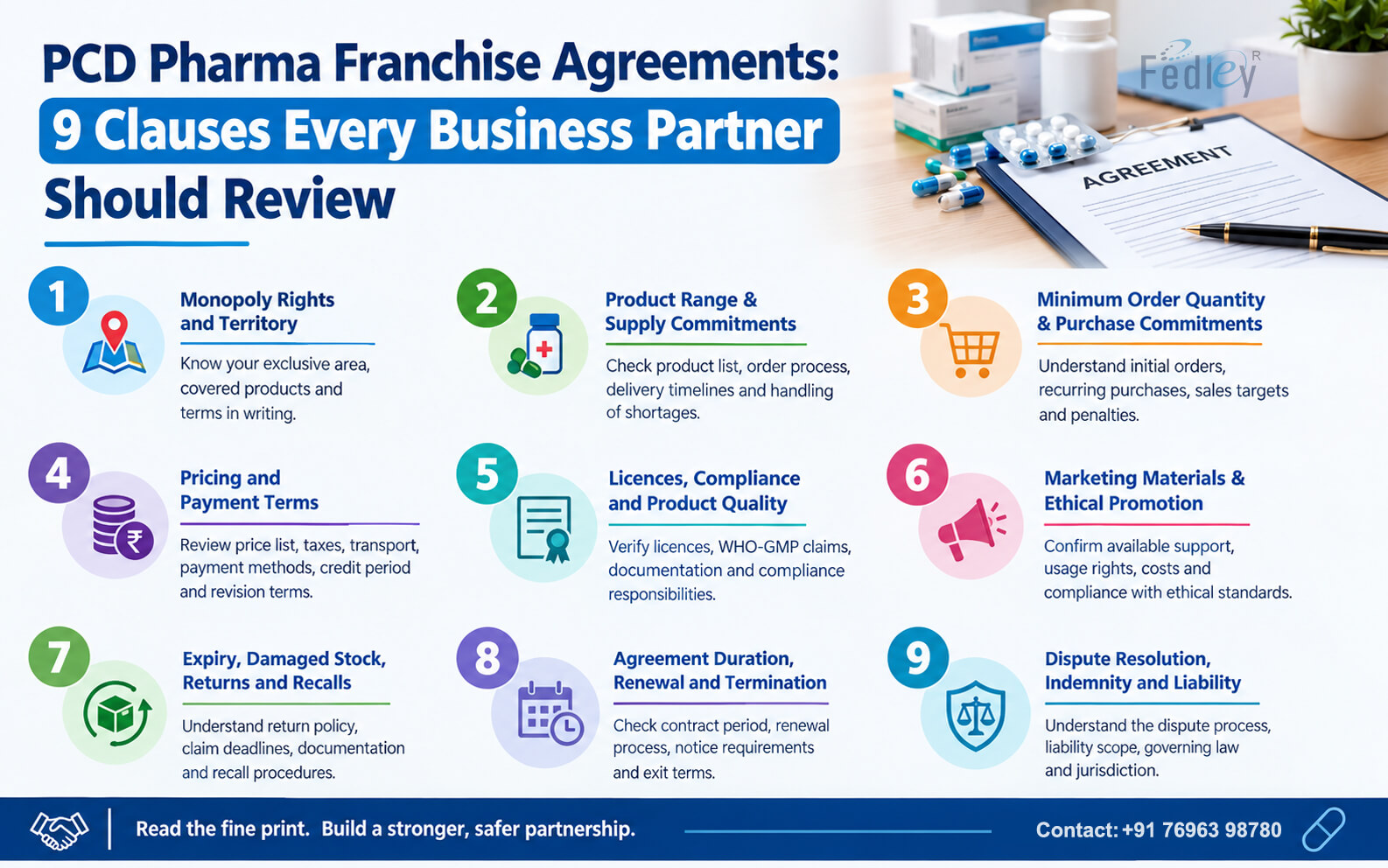
5. Licences, Regulatory Compliance, and Product Quality
Pharmaceutical distribution involves responsibilities that extend beyond ordinary commercial transactions. Before entering a partnership, verify the relevant licences, registrations, product documentation, and manufacturing credentials.
If a company describes its products as WHO-GMP certified pharmaceutical products, verify the relevant certificate, issuing authority, manufacturing site, scope, and validity. Do not treat a marketing statement as proof of certification.
The agreement should clarify responsibilities relating to:
- Applicable drug licences and registrations.
- Storage and handling requirements.
- Invoices, batch information, and supporting documentation.
- Reporting product-quality concerns.
- Cooperation during inspections, recalls, or regulatory inquiries.
The precise requirements depend on your business activities, products, and applicable Indian regulations. Seek professional guidance if you are unsure which permissions or responsibilities apply.
Good documentation supports product traceability and helps both parties understand their compliance obligations.
What to remember: Verify quality claims and clarify which party is responsible for each applicable regulatory requirement.
6. Pharma Franchise Marketing Materials and Ethical Promotion
Marketing support can help franchise partners introduce products and develop relationships with potential customers. However, the agreement should specify what support is actually available.
Ask whether the company supplies product literature, visual aids, approved promotional materials, training, or other resources. Confirm who pays for these items and whether approval is required before using them.
The pharma franchise marketing materials clause should address:
- The types of promotional resources provided.
- Permission to use company names, logos, and product images.
- Restrictions on modifying approved materials.
- Responsibility for local promotional expenses.
- Procedures for updating outdated information.
Ethical Promotion is equally important. Promotional claims should be accurate, appropriately supported, and consistent with applicable laws and industry requirements.
Avoid unsupported statements about medicine effectiveness, guaranteed sales, or medical benefits. Responsible promotion protects professional credibility and supports lasting business relationships.
What to remember: Confirm the availability, permitted use, and cost of promotional support before building your marketing plan.
7. Expiry, Damaged Stock, Returns, and Product Recalls
Stock-related terms are easy to overlook when you are focused on launching your business. However, unclear return conditions can lead to disagreements when products are damaged, approaching expiry, or subject to a recall.
Before signing, determine whether the agreement provides a return, replacement, or credit process for eligible products. Do not assume that all unsold or expired medicines are automatically returnable.
Review the written policy for:
- Eligibility conditions for returns or replacements.
- Deadlines for submitting claims.
- Required documentation and packaging.
- Responsibility for transportation and related costs.
- Procedures for defective or recalled products.
- Treatment of near-expiry inventory.
For example, the agreement may require damaged goods to be reported within a specified period and supported by delivery records or photographs. Understanding the procedure beforehand can help you respond correctly when a problem occurs.
Maintain suitable inventory records, follow the specified storage conditions, and comply with applicable requirements for expired or recalled medicines.
What to remember: Understand the return and recall procedures before placing your first order.
8. Agreement Duration, Renewal, and Termination
Every business partnership needs clear rules governing its duration and the circumstances in which it can end.
Review the contract's start date, duration, renewal process, and termination conditions. Pay particular attention to notice requirements and whether either party has an opportunity to correct a contractual breach before termination.
The agreement should explain:
- The initial contract period.
- The procedure and deadline for renewal.
- Grounds for suspension or termination.
- Applicable notice periods.
- Treatment of outstanding payments and remaining inventory.
- Obligations involving company property, branding, and confidential information.
Consider what happens if you decide to leave the partnership voluntarily. A clearly defined exit process can help both parties settle outstanding matters and reduce uncertainty.
If the agreement contains substantial penalties, restrictive obligations, or unclear post-termination conditions, consider seeking legal advice before signing.
What to remember: Understand how the partnership starts, continues, and ends before committing your investment.
9. Dispute Resolution, Indemnity, and Liability
Even well-planned business relationships can encounter disagreements. Your agreement should explain how disputes are handled and how responsibilities are allocated when something goes wrong.
Review the dispute resolution clause to understand the process for raising complaints, attempting settlement, and proceeding to arbitration or court where applicable.
Other important provisions include:
- The scope of indemnity obligations.
- Responsibility for product-quality and distribution-related issues.
- Governing law and jurisdiction.
- Procedures for documenting and escalating complaints.
- Treatment of outstanding obligations during a dispute.
Do not accept broad liability provisions without understanding their consequences. A clause that assigns responsibility for losses without clearly defining the circumstances can create uncertainty for both parties.
A qualified legal professional can help you assess the allocation of risk and determine whether the proposed terms are appropriate for your business.
What to remember: Ensure that the agreement explains how disputes will be resolved and how liability is allocated.
Red Flags to Watch for Before Signing
After reviewing the nine clauses, look for terms that require further clarification.
- Unclear monopoly rights: Exclusivity is promised verbally but not documented.
- Unexplained charges: Additional fees or price changes are not adequately described.
- Unrealistic purchase commitments: Order targets are difficult to reconcile with expected demand.
- Missing return procedures: The agreement does not explain how eligible damaged, near-expiry, or recalled stock is handled.
- One-sided termination conditions: Exit obligations or penalties are difficult to understand.
- Unverified product claims: Quality or certification statements cannot be supported by appropriate documentation.
These warning signs do not automatically mean that you should reject a partnership. Instead, request clarification, obtain written confirmation, and seek legal advice where necessary.
PCD Pharma Franchise Agreement Checklist
Use this table as a quick reference before signing.
Clause | What to verify |
Territory | Geographical boundaries and exclusivity conditions |
Products | Covered product range and supply procedures |
Orders | Initial and recurring purchase commitments |
Payments | Prices, deadlines, and additional costs |
Compliance | Applicable licences and product documentation |
Marketing | Available support and permitted promotional claims |
Returns | Eligibility, deadlines, and recall procedures |
Termination | Renewal, notice, and exit obligations |
Disputes | Liability, governing law, and resolution process |
Keep a copy of the signed agreement, schedules, relevant price lists, and applicable policies. Any subsequent changes to important terms should be documented appropriately.
Conclusion
A carefully reviewed agreement can help establish clearer expectations and a more informed business relationship. Before signing a PCD pharma franchise agreement, examine the nine essential clauses covering monopoly rights, product supply, minimum orders, pricing, compliance, marketing, returns, termination, and dispute resolution.
Take time to verify documentation, calculate your potential costs, and clarify any terms that could affect your investment. A promising product portfolio is important, but the contractual conditions deserve equal attention.
If you are considering a pharmaceutical distribution partnership, explore Fedley Healthcare's PCD Franchise Services to learn about its published franchise offering and determine whether it aligns with your business requirements. Evaluate the actual agreement, available products, and support arrangements before making a commitment.
Contact Fedley Healthcare
Address: Plot No. 201, Ground Floor, HSIIDC, Alipur, Phase 1, Industrial Area, Barwala (PKL), Haryana – 134118
Email: fedleycare@gmail.com
Phone: +91-9855986633 / +91-9317692852 / +91-9888656719
Website: https://fedleyhealthcare.com/
You can also explore PCD Franchise Services and learn about Third-Party Manufacturing through the company's website.
Frequently Asked Questions
1. What is a PCD pharma franchise agreement?
A PCD pharma franchise agreement is a written contract that defines the relationship between a pharmaceutical company and its franchise partner. It may cover territorial rights, products, purchasing requirements, payments, marketing support, regulatory responsibilities, and termination conditions.
2. Are monopoly rights guaranteed in every PCD pharma franchise?
No. Monopoly rights depend on the written agreement. Review the territory, covered products, exclusivity conditions, exceptions, and any sales or purchasing requirements before assuming that you have exclusive distribution rights.
3. What payment terms should I check before signing?
Check product prices, payment deadlines, applicable charges, credit conditions if offered, and procedures for price revisions or overdue balances. Confirm important financial terms in writing.
4. Can I return expired or damaged pharmaceutical products?
That depends on the applicable return policy, contractual terms, and relevant legal requirements. Check eligibility criteria, reporting deadlines, supporting documentation, and procedures for defective or recalled products before placing orders.
5. Why should a lawyer review a pharma franchise agreement?
A lawyer can help identify unclear obligations, assess termination provisions, review liability allocation, and explain potential legal risks. Professional review is particularly useful when the contract involves substantial investment, exclusivity restrictions, or significant financial penalties.
Disclaimer: This article provides general educational information and does not constitute legal advice. Contractual rights, licensing requirements, and pharmaceutical compliance obligations depend on the specific agreement and applicable law. Verify company-specific policies and product certifications before publication or entering into a partnership.