Before You Sign the Deal: How to Audit a Third-Party Pharmaceutical Manufacturer
Introduction: The Wrong Manufacturing Partner Can Cost More Than Money
A low quotation can look attractive. A large product catalogue can create confidence. And a promise of fast delivery can make a manufacturing deal seem like an easy win.
But what if the manufacturer cannot provide complete batch records? What if quality issues appear after production? Or what if the facility cannot meet your growing order requirements?
Suddenly, the deal that looked profitable becomes a business risk.
Choosing the right third-party pharmaceutical manufacturer requires more than comparing prices and product lists. You need evidence that the company can maintain quality standards, follow applicable regulations, manage production efficiently, and communicate transparently.
That is why a proper pharmaceutical manufacturer audit matters. It helps you identify warning signs, verify important claims, and assess whether a potential partner is genuinely suitable for your business.
Whether you are launching a new pharma brand or expanding an existing portfolio, here is how to audit a manufacturer before signing on the dotted line.
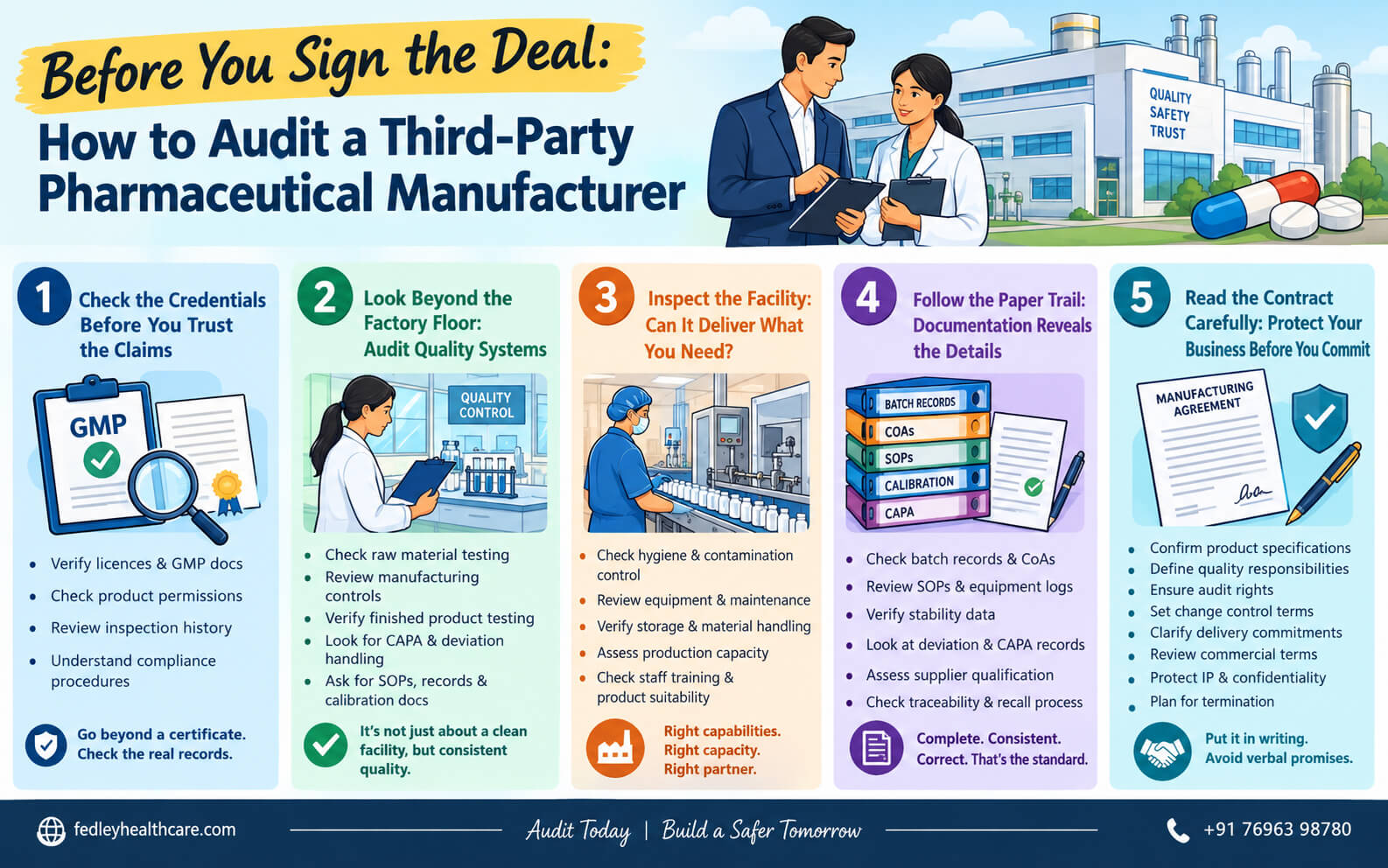
Check the Credentials Before You Trust the Claims
Would you trust a manufacturer simply because it says it follows GMP standards? You should not have to.
Your first step is to verify the manufacturer's regulatory documentation and determine whether its manufacturing activities are authorized for your intended products.
A thorough GMP compliance audit should examine:
- Manufacturing licences: Confirm that relevant licences are valid and cover the proposed activities.
- GMP documentation: Verify the issuing authority, facility details, validity, and applicable scope.
- Product permissions: Check that the manufacturer is authorized to produce the relevant product categories.
- Inspection history: Review available regulatory observations and corrective actions.
- Compliance procedures: Understand how the company manages deviations, complaints, and recalls.
Do not stop at a certificate displayed on a website. Verify the supporting evidence through appropriate regulatory channels whenever possible.
A credible manufacturing partner should be able to explain its compliance arrangements clearly and provide relevant documentation for review.
For more information about the company, visit About Fedley Healthcare.
Look Beyond the Factory Floor: Audit Quality Systems
A clean facility is important, but appearance alone cannot tell you whether a manufacturer consistently produces products that meet approved specifications.
The real test is its pharmaceutical quality control system.
During a pharmaceutical quality assurance audit, investigate how quality is managed from the moment raw materials arrive until the finished product is approved for release.
Ask questions such as:
- Are incoming raw materials tested and approved before use?
- Are critical manufacturing steps monitored and documented?
- Are finished products tested against approved specifications?
- How are unexpected results and deviations investigated?
- Are corrective and preventive actions (CAPA) documented and followed up?
- How are changes to materials, equipment, and manufacturing processes controlled?
Request appropriate evidence, such as standard operating procedures (SOPs), testing records, equipment calibration documentation, and examples of quality investigations.
Pay special attention to recurring issues. A manufacturer may experience occasional problems, but its response should demonstrate a systematic approach to investigation and prevention.
A reliable partner should be able to explain who approves product release, how quality decisions are documented, and what happens when a batch fails to meet requirements.
Learn more about pharmaceutical manufacturing standards.
Inspect the Facility: Can It Deliver What Your Business Needs?
A manufacturer's production capacity should match your actual requirements, not just the figures presented during a sales discussion.
An effective pharmaceutical manufacturing facility audit examines whether the premises, equipment, personnel, and operating procedures are suitable for your intended products.
Here is what deserves your attention:
01. Facility hygiene and contamination control: Review cleaning procedures, sanitation practices, segregation arrangements, and measures to prevent product mix-ups.
02. Equipment and maintenance: Check whether machinery is suitable for the required dosage forms and whether maintenance and calibration records are available.
03. Storage and material handling: Verify that raw materials, packaging components, and finished products are stored under appropriate conditions.
04. Production capacity: Ask about current workloads, manufacturing schedules, expected lead times, and the ability to accommodate higher order volumes.
05. Staff training: Review how employees are trained for their responsibilities and how competency is maintained.
06. Product suitability: Confirm that the facility has the appropriate capabilities for your specific formulations and packaging requirements.
An on-site inspection is often valuable. If it is not practical, consider a qualified independent auditor or an appropriately documented remote assessment.
Remember, the objective is not to find the biggest factory. It is to find a manufacturer with the right capabilities, controlled processes, and capacity to support your business consistently.
Follow the Paper Trail: Documentation Reveals the Details
In pharmaceutical manufacturing, important processes must be supported by appropriate records. Without reliable documentation, it becomes difficult to establish what happened during production or investigate a quality problem.
Your pharmaceutical manufacturer audit checklist should include the following records, as relevant to the product and audit scope:
- Batch manufacturing records: Evidence of production steps, material usage, and process controls.
- Certificates of analysis (CoAs): Relevant laboratory results for raw materials and finished products.
- Standard operating procedures: Written instructions for important manufacturing and quality activities.
- Equipment records: Maintenance, calibration, and qualification documentation.
- Stability data: Supporting evidence for applicable shelf-life claims.
- Deviation and CAPA records: Investigations, root-cause analysis, and corrective actions.
- Supplier qualification records: Evidence that critical raw material suppliers are assessed and approved.
- Traceability and recall procedures: Processes for identifying affected batches and responding to product issues.
Do not merely confirm that documents exist. Check whether they are complete, consistent, appropriately approved, and available when required.
You should also assess pharmaceutical supply chain risk. Ask how the manufacturer manages material shortages, supplier changes, transport delays, and unexpected interruptions.
Strong documentation and traceability help support investigations, improve accountability, and reduce uncertainty when problems arise.
Read the Contract Carefully: Protect Your Business Before You Commit
You may find a manufacturer with suitable facilities and promising quality systems, but unclear contractual responsibilities can still create serious problems.
Before signing, review the proposed pharmaceutical manufacturing agreement with the appropriate quality, regulatory, and legal professionals.
Make sure it addresses:
- Product specifications: Agreed quality, packaging, and labelling requirements.
- Quality responsibilities: Testing, batch release, documentation, complaints, and recalls.
- Audit rights: Appropriate access to relevant records and facilities.
- Change control: Notification and approval requirements for significant changes.
- Delivery commitments: Lead times, order quantities, delays, and supply arrangements.
- Commercial terms: Pricing, payment conditions, and minimum order quantities.
- Intellectual property: Ownership of formulations, artwork, and relevant documentation.
- Confidentiality and termination: Protection of business information and exit arrangements.
A separate pharmaceutical quality agreement can help clarify quality-related responsibilities and escalation procedures.
Never rely solely on verbal promises about product quality, production capacity, delivery timelines, or exclusivity. Important commitments should be documented.
If you are comparing outsourcing options, explore Third Party Manufacturing for Your Business.
Your Pre-Deal Pharmaceutical Manufacturer Audit Checklist
Before approving a partner, use this quick-reference third-party pharma manufacturer audit checklist to organize your findings.
What to audit | Questions to ask | Evidence to review |
Regulatory compliance | Are applicable licences and approvals valid? | Licences and GMP documentation |
Quality control | Are testing and investigation procedures effective? | SOPs and relevant quality records |
Manufacturing facility | Is the site suitable for your products? | Inspection findings and equipment records |
Documentation | Can products and materials be traced? | Batch records and relevant CoAs |
Supply chain | Are critical suppliers assessed? | Supplier qualification records |
Production capacity | Can the manufacturer meet your demand? | Production schedules and capacity information |
Contract terms | Are responsibilities clearly defined? | Manufacturing and quality agreements |
Communication | Are complaints and delays handled systematically? | Written procedures and escalation contacts |
Classify each item as verified, pending, or requiring corrective action. Resolve critical concerns before signing the agreement.
Red Flags You Should Never Ignore
Not every manufacturer that makes a mistake is unsuitable. What matters is how serious the issue is, whether it indicates a wider problem, and how effectively it is addressed.
However, these warning signs deserve closer investigation:
- Expired, inconsistent, or unverifiable regulatory documentation.
- Missing or contradictory batch manufacturing records.
- Repeated quality issues without effective corrective action.
- Unclear responsibility for testing and batch release.
- Undocumented changes to materials or manufacturing processes.
- Weak supplier controls or product traceability.
- Reluctance to provide reasonable evidence of compliance.
- Unrealistic production promises or vague contractual commitments.
If a significant concern remains unresolved, request a documented corrective action plan and appropriate evidence of its effectiveness. Escalate serious compliance and product-safety concerns to qualified professionals before proceeding.
A promising quotation should never outweigh an unresolved quality risk.
New Pharma Trend for 2026-27: QR-Code Drug Tracking and Anti-Counterfeit Compliance
Can you verify where a medicine came from and whether its packaging is authentic? Drug traceability is becoming an increasingly important consideration for pharmaceutical manufacturers, distributors, and brand owners in India.
On 25 June 2026, India’s Ministry of Health and Family Welfare announced an expansion of QR-code-based drug traceability requirements to cover additional categories, including vaccines, antimicrobials, anti-cancer medicines, and specified narcotic and psychotropic drugs. The implementation dates are phased: 1 July 2027 for vaccines, narcotic and psychotropic drugs, and anti-cancer medicines, and 1 July 2028 for antimicrobials. Businesses should check the applicable notification and product-specific requirements before relying on these dates.
For businesses choosing a third-party pharmaceutical manufacturer, this development makes packaging controls, accurate batch information, and product traceability important topics to discuss before signing a deal.
What should you check during a manufacturer audit?
- QR-code and barcode capabilities: Determine whether the facility can support the coding and packaging requirements applicable to your products.
- Accurate product information: Check how batch numbers, manufacturing dates, expiry dates, and other required product details are verified.
- Packaging-line controls: Ask how the manufacturer prevents incorrect, duplicated, missing, or mismatched codes.
- Batch traceability: Confirm that finished packs can be linked to relevant manufacturing and packaging records.
- Regulatory readiness: Establish who is responsible for implementation, testing, documentation, and ongoing compliance under the manufacturing agreement.
Questions to Ask Before Signing
- Can your packaging line accommodate the applicable barcode or QR-code requirements for our product?
- How do you verify printed codes and reconcile packaging materials?
- Who is responsible for maintaining accurate product and batch information?
- How are coding errors investigated and documented?
- Can you provide evidence that your proposed process meets the requirements applicable to our product and market?
Why this matters: Weak packaging controls can create traceability gaps, delay product release, and complicate investigations or recalls. Evaluating these systems early can help businesses identify implementation needs before production begins.
Important: QR-code obligations depend on the applicable regulations and product category. This section is informational and is not a substitute for checking the current legal notification or obtaining regulatory advice.
Official government announcement — Ministry of Health and Family Welfare via PIB: Union Health Ministry Expands QR Code-Based Drug Traceability Framework
Recommendation: Cite the PIB announcement in your blog for the general explanation, and link to the relevant Gazette notification for the underlying regulatory details. Before publishing, verify the notification's exact wording and applicable implementation dates.
Your Pharma Vision. Our Next Conversation. Discover Fedley Healthcare.
From franchise opportunities to manufacturing partnerships, the pharmaceutical industry offers multiple paths to growth. The key is knowing where to begin.
Meet Fedley Healthcare. Explore our company, discover pharmaceutical business possibilities, and find the information you need to take your next step with confidence.
Six Ways to Explore the World of Fedley Healthcare
01. Know the Company Behind the Opportunity
Every business relationship begins with understanding your potential partner. Discover the company, its background, and its pharmaceutical business focus.
02. Explore Your PCD Pharma Franchise Journey
Thinking about entering the pharmaceutical distribution business? Explore the PCD pharma franchise model, evaluate available product opportunities, and understand the commercial terms before getting started.
Your next business chapter could begin with the right questions.
03. Turn Manufacturing Needs Into a Clearer Plan
Looking for a manufacturing partner for your pharmaceutical products? Explore third-party pharmaceutical manufacturing and understand how the right manufacturing arrangement can support your product and business goals.
04. Make Ethical Promotion Part of Your Business Identity
In healthcare, credibility matters. Responsible communication, accurate product information, and ethical pharmaceutical promotion help put trust at the centre of professional relationships.
Explore relevant company resources and applicable industry guidelines.
05. Think Beyond Borders With Pharmaceutical Exports
Interested in international pharmaceutical markets? Before exploring medicine exports, consider destination-country regulations, product registrations, documentation, and distribution requirements. Contact Fedley Healthcare to confirm its current export capabilities and supported markets.
06. Understand What Makes Pharmaceutical Manufacturing Matter
Quality and manufacturing standards are essential considerations when assessing a potential supplier. Learn more about their role in the wider healthcare industry.
One Enquiry Could Be the Start of Something Bigger
Whether you are researching a PCD pharma franchise, evaluating a third-party manufacturing partner, or exploring pharmaceutical business opportunities, start with a conversation that focuses on your actual requirements.
Let's talk pharma. Let's explore possibilities.
Fedley Healthcare — Contact Details
- Address: Plot No. 201, Ground Floor, HSIIDC, Alipur, Phase 1, Industrial Area, Barwala (PKL), Haryana – 134118
- Email: fedleycare@gmail.com
- Phone: +91-9855986633 | +91-9317692852 | +91-9888656719
- Website: Visit Fedley Healthcare
Have a pharmaceutical business goal in mind? Reach out to Fedley Healthcare to discuss your requirements and explore the next steps.
Conclusion: The Best Deal Is the One You Can Trust
Choosing a pharmaceutical manufacturing partner is about protecting more than your budget. It is about establishing a dependable relationship that supports consistent quality, regulatory compliance, and sustainable business growth.
A structured third-party pharmaceutical manufacturer audit helps you assess the risks before they become expensive problems. By checking GMP compliance, reviewing quality systems, verifying documentation, inspecting production capabilities, and clarifying contractual responsibilities, you can make a more informed decision.
If you are exploring outsourcing options, visit Fedley Healthcare's Third-Party Manufacturing services to learn more about its stated service offering. Evaluate the relevant capabilities and supporting documentation against your specific requirements.
Ready to discuss your manufacturing needs? Visit the Fedley Healthcare contact page.
Audit carefully. Ask better questions. Choose your manufacturing partner with confidence.
Frequently Asked Questions
01. What should you check before choosing a third-party pharmaceutical manufacturer?
Review applicable manufacturing licences, GMP compliance, quality assurance systems, facility suitability, documentation, production capacity, supplier reliability, and contractual responsibilities.
02. Which documents are important during a pharmaceutical manufacturer audit?
Depending on the product and scope, review manufacturing licences, GMP documentation, SOPs, batch records, certificates of analysis, equipment records, stability data, deviation reports, and CAPA documentation.
03. How can you verify GMP compliance?
Check the issuing authority, validity, facility address, and scope of the relevant documents. Where possible, verify their authenticity independently through the appropriate regulatory authority.
04. Should you visit the manufacturing facility before signing a deal?
An on-site audit can help you assess actual operating practices, equipment, hygiene, and facility controls. The appropriate audit method depends on product risk, applicable requirements, and the evidence available.
05. What is a pharmaceutical quality agreement?
A pharmaceutical quality agreement documents the parties' quality-related responsibilities, including testing, deviations, change control, documentation, complaints, and recalls. It should align with the main manufacturing agreement.
06. How do you choose the right pharmaceutical manufacturing partner?
Compare verified compliance, quality systems, production capabilities, traceability, communication, delivery performance, and contractual transparency. Choose a partner based on evidence and suitability rather than price alone.
Disclaimer: The information in this article is provided for general educational and informational purposes only. It should not be considered legal, medical, regulatory, or professional advice. Pharmaceutical regulations, manufacturing standards, and compliance requirements may change over time and differ by jurisdiction. Readers should consult official regulatory sources and qualified professionals before making decisions. While reasonable care has been taken to prepare this content, no guarantee is made regarding its accuracy, completeness, or suitability for specific circumstances.