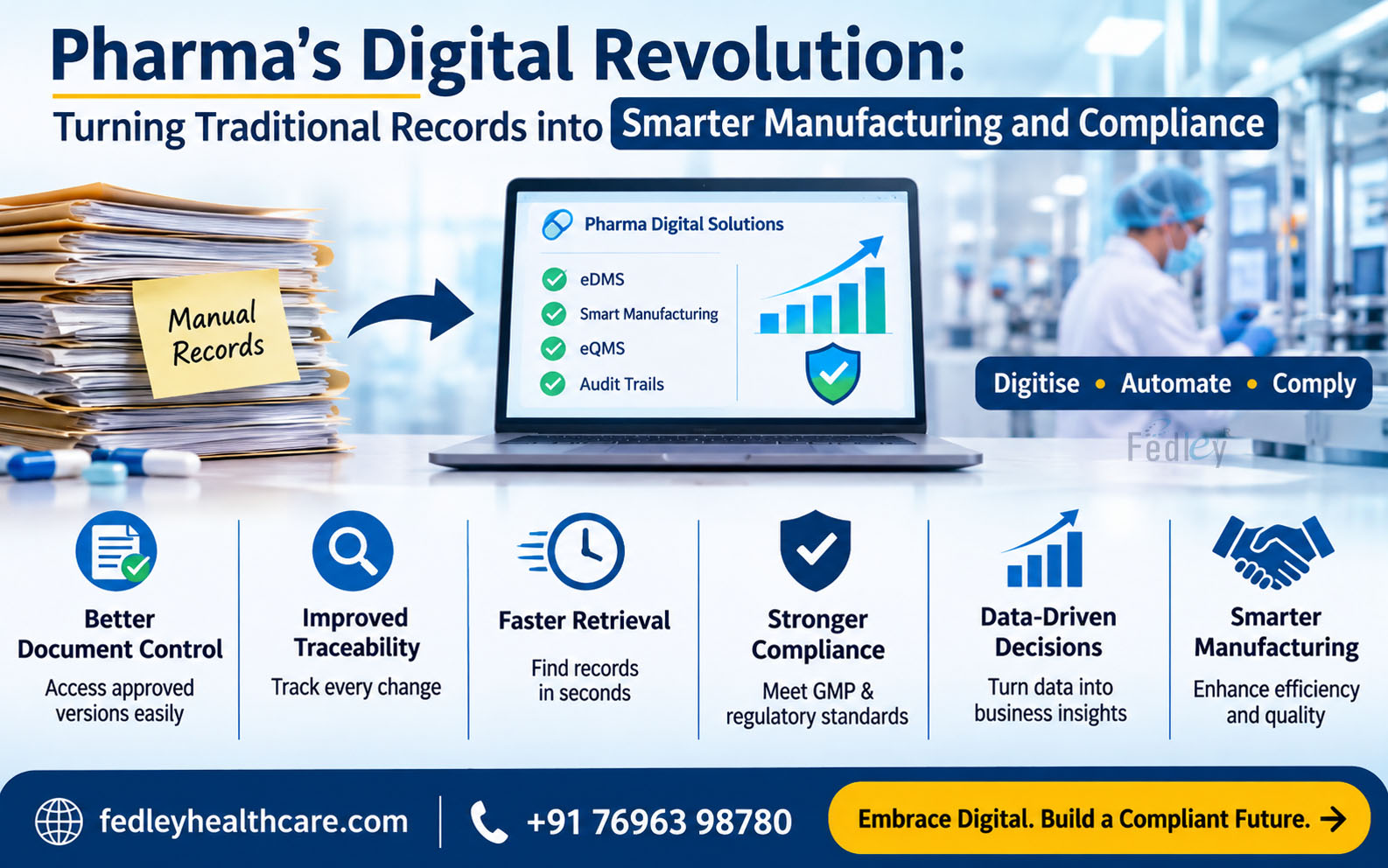
Pharma's Digital Revolution: Turning Traditional Records into Smarter Manufacturing and Compliance
Introduction: Can Pharmaceutical Manufacturing Keep Up with a Digital World?
A pharmaceutical company may have modern manufacturing equipment, experienced professionals, and a promising product portfolio. But what happens when an important production record cannot be located, a document approval gets delayed, or two departments work with different versions of the same information?
These situations highlight a challenge that technology is increasingly helping the pharmaceutical industry address.
For years, pharmaceutical businesses have relied on physical registers, handwritten entries, printed reports, and manual approval systems. Although these methods remain relevant in certain operations, managing growing documentation requirements through disconnected processes can make everyday activities more complicated.
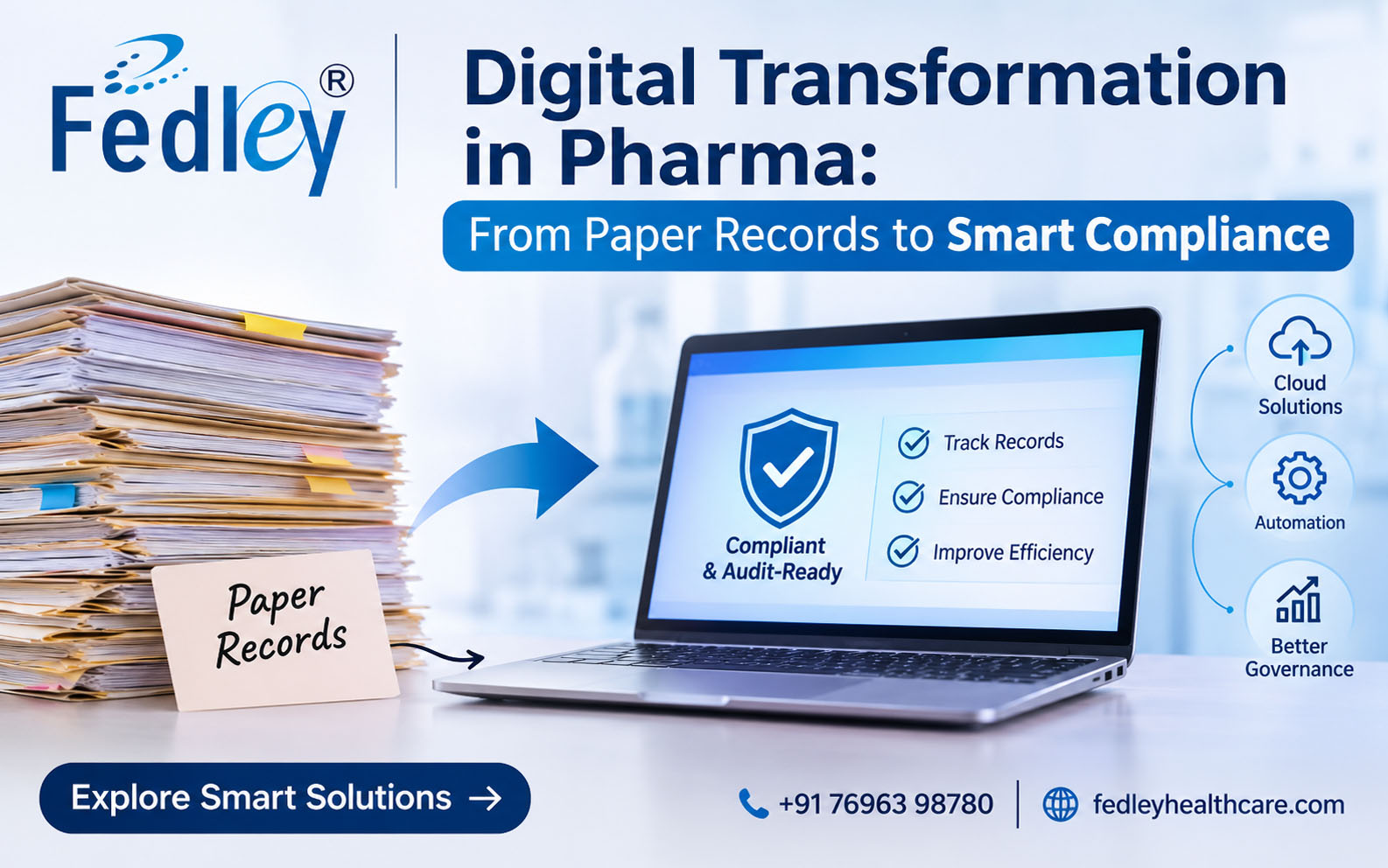
This is where Digital Transformation in Pharma is changing the conversation.
The modern pharmaceutical industry is moving towards smart pharmaceutical manufacturing, electronic documentation, automated workflows, and better information management. These developments are helping companies improve operational visibility, organise quality-related activities, and strengthen their approach to regulatory responsibilities.
However, digitalisation is not simply about replacing paper with screens. It is about creating a more connected manufacturing environment where information is accurate, accessible and properly controlled.
For pharmaceutical manufacturers, franchise businesses and third-party manufacturing partners, understanding this transition is becoming increasingly important.
The Paperwork Problem: Why Traditional Pharma Operations Need an Upgrade
Behind every pharmaceutical product is a detailed process involving materials, manufacturing activities, quality checks, packaging, and distribution. Each activity generates information that needs appropriate documentation.
When companies maintain this information entirely through manual processes, managing it becomes difficult as operations expand.
Consider a pharmaceutical manufacturer maintaining hundreds of production records every month. Employees may need to collect information from different departments, verify entries, obtain approvals, and store documents for future reference.
A single misplaced record can create unnecessary administrative work.
Some common challenges associated with traditional documentation include:
- Manual documentation errors: Repeated handwriting and data entry can increase the possibility of mistakes.
- Delayed document approvals: Physical movement of files can slow down review procedures.
- Poor document visibility: Employees may struggle to identify the latest approved version.
- Difficult record retrieval: Historical information can take considerable time to locate.
- Limited operational coordination: Separate departments may maintain disconnected records.
These issues explain why pharmaceutical digitalisation is becoming an important part of modern business planning.
The objective is not to eliminate every paper-based process immediately. It is to identify where digital systems can improve efficiency, traceability, and documentation control.
Electronic Documentation: Making Pharmaceutical Information Easier to Manage
Documentation is not just an administrative requirement in pharmaceutical manufacturing. It provides evidence of how activities were performed and whether established procedures were followed.
A well-designed digital documentation strategy in pharma can help businesses organise information in a more structured manner.
What Does a Digital Documentation System Actually Manage?
An Electronic Document Management System (EDMS) can help companies control important records throughout their lifecycle.
Traditional documentation | Digital documentation |
Physical SOP files | Controlled electronic SOPs |
Handwritten batch records | Electronic batch manufacturing records |
Paper approval signatures | Controlled electronic approvals |
Physical quality reports | Electronic quality documentation |
Manual document tracking | Digital version tracking |
Physical record storage | Controlled electronic record storage |
The transition offers several practical advantages.
Better document control: Employees can access authorised versions of approved documents.
Improved traceability: Appropriate system records can help identify document changes and approvals.
Faster retrieval: Electronic search facilities can reduce time spent locating historical information.
Organised workflows: Document review and approval can follow defined digital procedures.
However, businesses must ensure that electronic systems are suitable for their intended purpose and supported by appropriate validation, security, backup and access controls.
Simply scanning paper files does not automatically establish a compliant electronic documentation process.
Smart Manufacturing: Where Digital Technology Enters the Production Process
The next phase of pharmaceutical digitalisation extends beyond document storage. It involves improving the way production activities are monitored, coordinated, and evaluated.
Smart pharmaceutical manufacturing combines appropriate digital technologies with established manufacturing practices to improve operational visibility.
The medicine manufacturing process includes multiple stages, each requiring suitable controls and accurate information.
Here are some technologies contributing to this transformation.
A. Manufacturing Execution Systems (MES)
MES platforms help manage and monitor manufacturing activities. Depending on their configuration, they can support production scheduling, batch tracking, workflow management, and manufacturing records.
They can also help connect relevant production information with other business systems.
B. Artificial Intelligence and Predictive Analytics
Artificial Intelligence in Pharma is creating opportunities to analyse manufacturing data and identify operational patterns.
Potential applications include:
- Predictive equipment maintenance.
- Production trend analysis.
- Inventory planning.
- Identification of unusual operating patterns.
- Manufacturing performance evaluation.
AI-based outputs still require appropriate verification and qualified human oversight, especially when they influence quality-related decisions.
C. Internet of Things and Connected Equipment
The Industrial Internet of Things (IIoT) uses connected devices and sensors to collect selected operational information.
For example, monitoring systems may record temperature, humidity, or equipment performance where these parameters are relevant to the manufacturing process.
This information can help authorised teams monitor operations and investigate unusual variations.
The real advantage of smart manufacturing technologies comes when different systems work together through controlled information-sharing processes.
Digital Quality Management: Turning Compliance into a More Organised Process
Pharmaceutical compliance requires consistent procedures, reliable documentation and appropriate quality oversight.
As manufacturing operations become more complex, managing quality activities through disconnected files and manual communication can become challenging.
This is why Pharma Compliance Management is increasingly connected with digital quality systems.
An Electronic Quality Management System (eQMS) can support several important quality-related activities.
Quality function | Digital application | Operational benefit |
Deviation management | Electronic deviation reporting | Organised investigations |
CAPA | Corrective action tracking | Better follow-up visibility |
Change control | Digital approval workflows | Controlled changes |
Audit management | Electronic audit records | Easier documentation retrieval |
Training management | Digital training records | Improved training visibility |
Complaint management | Electronic complaint tracking | Structured follow-up |
Understanding the Importance of ALCOA+
One of the most important considerations in pharmaceutical documentation is data integrity in pharmaceutical manufacturing.
The ALCOA+ framework helps explain the characteristics expected of reliable records.
- Attributable: Records identify who performed an activity.
- Legible: Information remains readable.
- Contemporaneous: Activities are documented at the appropriate time.
- Original: Original information or verified true copies are maintained.
- Accurate: Entries correctly represent actual activities.
- Complete: Relevant information is not missing.
- Consistent: Records follow a logical sequence.
- Enduring: Information remains available throughout its required retention period.
- Available: Records can be retrieved when needed.
Why Digital Audit Trails Matter
A suitable electronic system can maintain digital audit trails showing relevant record creation, modifications, and user activities.
This can help quality teams investigate discrepancies, review changes and establish accountability.
In India, pharmaceutical manufacturers must also consider applicable GMP requirements under revised Schedule M, including provisions concerning documentation and computerised systems.
Importantly, digital compliance systems support regulatory responsibilities; they do not automatically guarantee compliance. Validation, documented procedures, employee training and effective quality oversight remain essential.
From Manufacturing Data to Better Business Decisions
One major advantage of digitalisation is the ability to organise operational information so that it becomes more useful for decision-making.
In traditional environments, managers may need to collect reports from multiple departments before understanding production performance.
With suitable pharmaceutical process automation and integrated reporting systems, relevant information can become easier to review.
For example, a manufacturing business may use digital reports to examine:
- Production schedules and completion status.
- Equipment maintenance requirements.
- Material availability and inventory movement.
- Quality investigation trends.
- Documentation review status.
- Employee training completion.
These insights can help management identify recurring issues and prioritise improvements.
However, digital reports are only as reliable as the information and controls behind them. Businesses should establish appropriate data review procedures and avoid making important decisions solely on unverified automated outputs.
The Human Element: Preparing Employees for Digital Pharmaceutical Operations
Even the most advanced software cannot deliver meaningful results if employees are not comfortable using it.
Digital transformation in pharmaceutical manufacturing requires changes in everyday working practices, responsibilities, and communication.
For this reason, employee training should be treated as an essential part of implementation.
Different departments need different training approaches.
Department | Important digital skills |
Manufacturing | Electronic production entries and workflow procedures |
Quality assurance | Digital reviews, approvals, and audit trails |
Warehouse | Inventory systems and traceability |
Regulatory affairs | Controlled documentation and record retrieval |
Management | Performance reporting and system oversight |
IT | Cybersecurity, access management, and system maintenance |
Companies should also establish clear procedures for system downtime, data recovery, error reporting and employee access management.
The goal is to make technology a useful part of daily work rather than an additional burden.
Digitalisation and the Growing Importance of Manufacturing Partnerships
Digital transformation also influences the way pharmaceutical businesses work with external manufacturers and distribution partners.
A third-party pharmaceutical manufacturing arrangement requires clear communication and well-defined responsibilities between the contracting company and the manufacturing organisation.
Documentation plays an important role in these relationships.
Before entering a manufacturing partnership, businesses should understand:
- Product specifications and approved formulations.
- Manufacturing and quality responsibilities.
- Batch documentation requirements.
- Testing and release procedures.
- Change management responsibilities.
- Complaint handling procedures.
- Record retention arrangements.
The concept of third-party manufacturing ethics in pharma also deserves attention.
Ethical partnerships should be based on transparency, responsible product promotion, appropriate quality practices, and clear business communication.
Fedley Healthcare: Supporting Pharmaceutical Business Opportunities
Fedley Healthcare operates in the pharmaceutical business sector, offering PCD Pharma Franchise and Third-Party Manufacturing opportunities.
For businesses exploring pharmaceutical partnerships, understanding a company's product portfolio, service arrangements, and quality-related practices is an important part of the evaluation process.
Its business activities connect with several areas of the pharmaceutical industry:
- PCD Franchise Services: Opportunities for pharmaceutical business development.
- Third-Party Manufacturing: Manufacturing-related business arrangements.
- Ethical Promotion: Responsible pharmaceutical product promotion.
- Quality-Assured Pharmaceutical Products: An important consideration when evaluating product and manufacturing arrangements.
Businesses interested in these services can visit Fedley Healthcare to explore its offerings and discuss their requirements.
A manufacturing partnership should always involve appropriate due diligence, documented agreements, and clear quality responsibilities. Digitalisation should be evaluated based on actual capabilities rather than assumed to be present in every manufacturing facility.
Five Practical Moves Towards a Smarter Pharmaceutical Business
Digital transformation does not require a pharmaceutical company to change every process simultaneously.
A gradual implementation strategy can make the transition more manageable.
1. Review existing systems: Identify documentation gaps, repeated activities, and inefficient workflows.
2. Prioritise important processes: Start with areas where electronic documentation or workflow improvements can provide clear operational benefits.
3. Select suitable technology: Evaluate EDMS, eQMS, MES, and ERP solutions according to business requirements.
4. Establish data protection measures: Implement appropriate validation, cybersecurity, backup, and access management.
5. Review progress regularly: Measure documentation quality, employee adoption, system performance, and operational improvements.
This structured approach can help businesses build a practical foundation for smart pharmaceutical manufacturing.
What Lies Ahead for the Digitally Connected Pharma Industry?
The pharmaceutical industry is moving towards more connected and information-driven operations.
Emerging technologies may create new opportunities in manufacturing analytics, predictive maintenance, digital supply chain management, and intelligent quality monitoring.
The future of pharmaceutical digital transformation will likely involve closer integration between manufacturing equipment, quality systems, and business information platforms.
At the same time, data security, regulatory responsibilities, and employee capabilities will remain important considerations.
Companies should focus on technologies that solve genuine operational problems rather than adopting digital tools simply because they are new.
Ultimately, the most effective transformation is one that improves the reliability of pharmaceutical operations while maintaining a strong commitment to product quality.
Building a Digitally Compliant Pharma Industry in India
India's pharmaceutical industry is moving towards smarter regulatory management through digital platforms, electronic documentation, and online licensing systems. The CDSCO's SUGAM portal supports digital regulatory services, helping streamline applications, licensing, and approval-related processes. Such initiatives demonstrate how technology can strengthen transparency and efficiency across pharmaceutical operations.
Source: CDSCO – IT Cell & E-Governance Initiatives (Central Drugs Standard Control Organisation, Government of India).
Conclusion: Better Technology, Stronger Processes, Greater Confidence
The pharmaceutical industry is moving beyond traditional documentation towards more connected and organised manufacturing environments.
The transition from paper records to digital pharmaceutical documentation, smart manufacturing technologies, and automated quality workflows can create meaningful improvements in operational visibility and information management.
However, successful transformation depends on more than software. It requires trained employees, appropriate system validation, reliable data management, and a consistent commitment to quality.
For pharmaceutical manufacturers, franchise businesses, and third-party manufacturing partners, the opportunity lies in combining technological progress with responsible business practices.
As the industry continues to evolve, Fedley Healthcare remains part of the pharmaceutical business ecosystem through its franchise and manufacturing-related opportunities. Building strong partnerships around quality, transparency, and ethical promotion will remain important for long-term business development.
About Fedley Healthcare
Fedley Healthcare is a pharmaceutical company based in Haryana, India, with business activities in pharmaceutical products and franchise-related opportunities. The company supports businesses exploring pharmaceutical product availability and manufacturing partnerships.
Contact Information
Fedley Healthcare
- Address: Plot No. 201, Ground Floor, HSIIDC, Alipur, Phase 1, Industrial Area, Barwala (PKL), Haryana-134118
- Email: fedleycare@gmail.com
- Phone: +91-9855986633, +91-9317692852, +91-9888656719
Frequently Asked Questions (FAQs)
1. What is digital transformation in pharma?
It refers to adopting digital technologies to improve pharmaceutical manufacturing, documentation, quality management, regulatory processes, and business operations.
2. Why is digital documentation important in pharmaceutical manufacturing?
It can improve document organisation, retrieval, version control, and traceability when supported by appropriate electronic system controls.
3. What are smart manufacturing technologies in pharma?
They include MES, automation, AI-based analytics, connected sensors, and digital monitoring systems that support manufacturing activities.
4. How does digitalisation support GMP compliance?
Digital systems can support controlled documentation, audit trails, electronic approvals, and record management. Appropriate validation and quality oversight remain necessary.
5. What is an electronic quality management system?
An eQMS is a digital platform used to manage quality activities such as deviations, CAPA, change control, audits, and training records.
6. Can small pharmaceutical businesses implement digital transformation?
Yes. They can begin with basic electronic documentation and gradually adopt additional systems based on operational requirements and available resources.
7. Does digital transformation eliminate the need for paper records?
Not necessarily. Some paper records may still be appropriate. The objective is to establish reliable, controlled documentation processes that meet applicable requirements.
Disclaimer: The content provided in this article is for general informational purposes and highlights emerging trends in pharmaceutical digitalisation, smart compliance, and modern manufacturing practices. It should not be considered legal, regulatory, or professional advice. Pharmaceutical companies must verify applicable industry standards, regulatory updates, and technology requirements before implementing any digital solutions. All decisions should be made in accordance with relevant pharmaceutical regulations and quality guidelines.