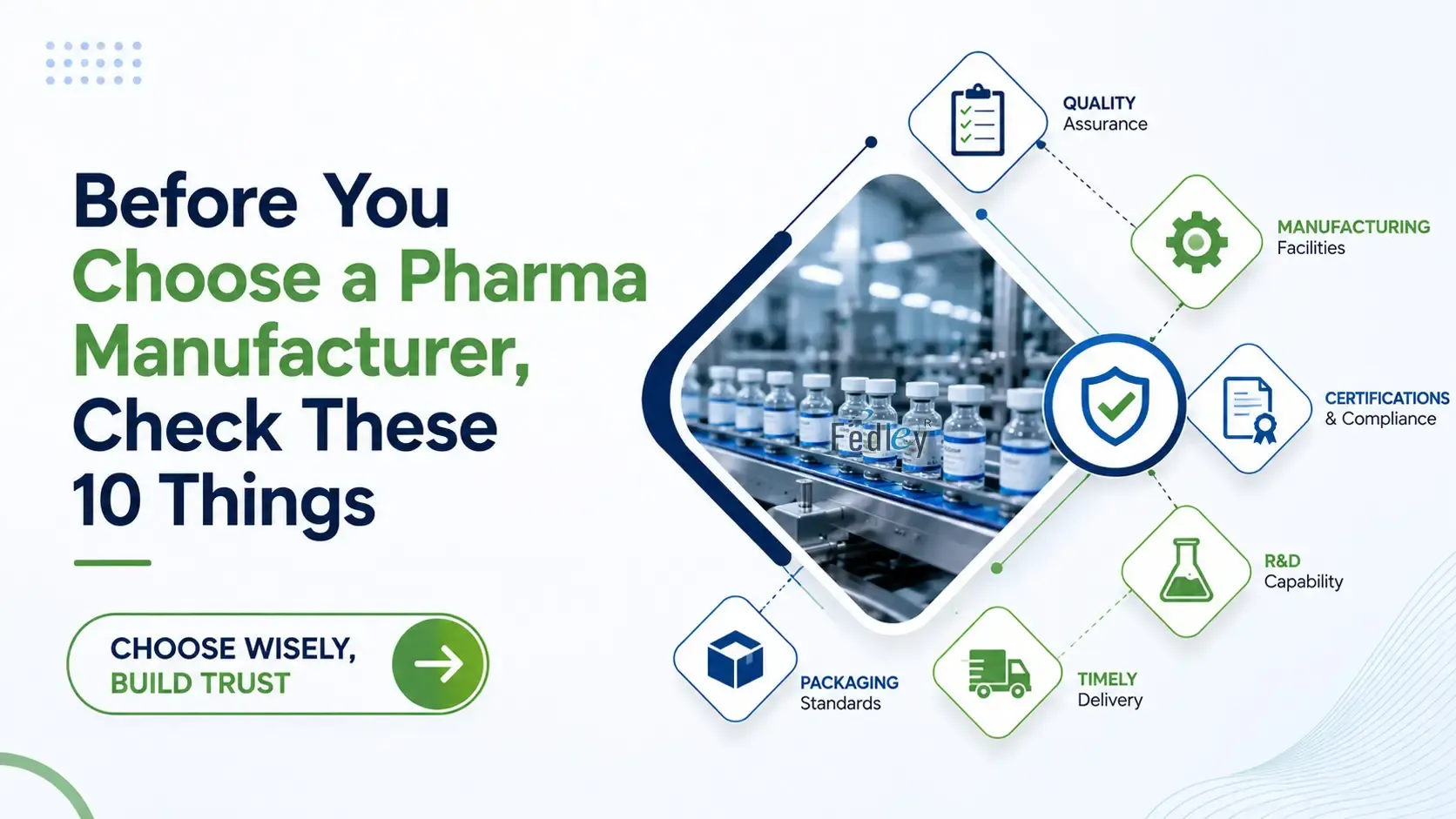
Choosing a pharma manufacturer is not simply about finding a company that can produce medicines at an attractive price. The manufacturer you select can influence product quality, regulatory compliance, delivery timelines, customer satisfaction, and the long-term growth of your business.
That is where many businesses make a mistake. They compare quotations first and ask questions about quality, capacity, certifications, and support later. By then, they may already be committed to a manufacturing relationship that is difficult to change.
Whether you are exploring third-party pharma manufacturing, contract manufacturing, or a long-term pharmaceutical production partnership, the selection process deserves careful attention.
A good manufacturing partner should provide more than production. It should offer dependable quality, appropriate infrastructure, transparent communication, consistent supply, and the ability to support your business as it grows.
If you are currently comparing manufacturers, it is also worth reviewing this guide on choosing the best medicine manufacturing company before making your final decision.
So, what should you actually check?
Here are 10 factors that can help you make a more informed choice.
Read also - Derma Pharma Products: Building Opportunities in the PCD Franchise Market
1. Don’t Start With Price - Start With Quality Credentials
A low quotation can certainly get your attention. But in pharmaceutical manufacturing, quality and regulatory compliance should come before price.
Before working with a manufacturer, ask about its applicable manufacturing licenses, GMP credentials, quality systems, and regulatory procedures. A professional pharmaceutical manufacturer should be able to clearly explain how it maintains manufacturing standards and product consistency.
WHO-GMP certification is one of the important credentials to investigate. Good Manufacturing Practices are designed around controlled production, documentation, hygiene, equipment, testing, and quality management.
But don't stop at asking whether a certificate exists. Find out whether the certification and manufacturing capabilities are relevant to the products and dosage forms you intend to produce.
What should you verify?
- WHO-GMP certification
- Applicable manufacturing licenses
- Quality management procedures
- Raw material testing
- Batch documentation
- Regulatory compliance
- Quality assurance practices
A manufacturer that treats compliance as part of everyday operations is more likely to give you confidence throughout the manufacturing process.
For additional context, explore Pharmaceutical Manufacturing in Global Healthcare.
2. Experience Matters More Than a Long Product List
A website may show hundreds of pharmaceutical products. That does not necessarily mean the manufacturer is the right choice for your requirements.
What matters is relevant pharmaceutical manufacturing experience.
A manufacturer experienced in your dosage form and therapeutic segment may understand production challenges, documentation requirements, quality expectations, and practical timelines more effectively than a company simply offering a large catalogue.
Ask about experience with products similar to yours. If you are planning tablets, capsules, oral liquids, or other dosage forms, determine whether the manufacturer has the necessary technical capabilities.
Look for:
- Relevant manufacturing experience
- Formulation expertise
- Qualified technical personnel
- Experience with similar products
- Understanding of regulatory requirements
- Established production processes
The goal isn't to find the manufacturer with the longest history. It is to find a company whose experience matches your product and business requirements.
3. Look Inside the Facility Before You Trust the Product
You don't have to judge a pharmaceutical manufacturing facility by how impressive it looks.
Instead, look at whether the infrastructure is suitable for controlled and consistent production.
A capable pharmaceutical manufacturing facility should have appropriate production areas, equipment, storage arrangements, testing capabilities, quality systems, and processes suited to the products being manufactured.
Technology is another factor worth considering. Modern equipment and organized manufacturing systems can support efficiency, consistency, and scalability.
As the pharmaceutical industry continues to evolve, healthcare innovations are influencing not only treatments but also formulation development, production technologies, quality systems, and supply processes.
Examine the manufacturer's:
- Manufacturing infrastructure
- Production equipment
- Storage facilities
- Quality-control laboratory
- Production environment
- Technology and automation
- Expansion capabilities
The important question is simple:
Can this facility reliably manufacture my products to the required standards?
For a deeper look at how pharmaceutical products move through manufacturing stages, see the Complete Medicine Manufacturing Process.
4. Ask One Question: How Is Every Batch Tested?
This is one of the most important conversations you can have with a potential manufacturer.
Don't simply ask, "Do you have quality control?"
Ask:
"What happens to my product from raw material testing to final batch release?"
A robust pharma quality control system should monitor the product throughout manufacturing. This can include raw material testing, in-process checks, finished-product testing, documentation, and procedures for handling deviations.
Quality assurance is broader than final product testing. It involves the systems and processes designed to prevent quality problems from occurring in the first place.
Key quality checkpoints include:
- Raw material testing
- In-process quality checks
- Finished-product testing
- Batch documentation
- Quality assurance procedures
- Deviation management
- Corrective and preventive actions
A reliable manufacturer should be comfortable explaining these processes.
If the answers are vague, overly technical without practical explanation, or difficult to verify, consider that a reason to investigate further.
5. Can They Manufacture What You Need Today and Tomorrow?
Your current product may be only the beginning.
Many pharmaceutical businesses gradually expand their portfolios after establishing market demand. That makes the manufacturer's product range and formulation capabilities important from the start.
Instead of asking only, "Can you manufacture this product?", consider asking:
"What else can you manufacture as our portfolio grows?"
A manufacturer with suitable capabilities across multiple dosage forms or therapeutic categories may give your business greater flexibility.
Consider:
- Tablets
- Capsules
- Oral liquids
- Different dosage forms
- Therapeutic categories
- Formulation capabilities
- Packaging options
- Product development support
A broad pharma manufacturer product range can also reduce the need to manage multiple manufacturing partners.
That can simplify communication, quality management, purchasing, and supply planning as your portfolio expands.
6. A Small Order Today Could Become a Big Order Tomorrow
Production capacity is easy to overlook when your business is just getting started.
Suppose your initial order is relatively small. A few months later, sales increase, distribution expands, and your requirements multiply.
Can the manufacturer keep up?
That is why pharma manufacturing capacity and scalability deserve attention before you sign an agreement.
Ask about current capacity, minimum order quantities, production scheduling, lead times, and how the company manages larger orders.
Ask about:
- Current production capacity
- Minimum order quantity
- Bulk manufacturing
- Production scheduling
- Lead times
- Capacity expansion
- Future scalability
This is particularly important for businesses using third-party pharma manufacturing. Your manufacturing requirements can change considerably as your product portfolio and market presence develop.
The ideal partner should be capable of supporting today's requirements without becoming a bottleneck tomorrow.
7. The Lowest Quote Isn't Always the Lowest Cost
Let's talk about pricing.
Yes, pharmaceutical manufacturing cost matters. But comparing manufacturers solely by the lowest quotation can create problems later.
Different quotations may include different components. One manufacturer may include packaging, testing, documentation, or certain services that another company charges separately.
Compare the Complete Commercial Picture
- Manufacturing Cost: Compare the per-unit or batch manufacturing price.
- MOQ: Check the minimum order quantity required by the manufacturer.
- Packaging: Review primary and secondary packaging costs and options.
- Testing: Confirm applicable quality-control and testing charges.
- Documentation: Check whether required product and regulatory documentation is included.
- Logistics: Consider transportation, shipping, and delivery costs.
- Payment Terms: Understand advance payment, balance payment, credit terms, and other conditions.
Tip: Don't choose a manufacturer based only on the lowest quotation. Compare quality, pricing, reliability, and overall value together.
The right question is not:
"Who is the cheapest pharma manufacturer?"
It is:
"Which manufacturer gives me the best overall value for the quality and service provided?"
A manufacturer that offers competitive pricing while maintaining dependable quality and supply can be more valuable than one offering an unusually low initial quotation.
8. Late Delivery Can Cost More Than Higher Manufacturing Prices
Imagine having market demand but no products available to fulfil it.
That is why pharmaceutical supply chain reliability matters.
Before selecting a manufacturer, discuss realistic production and delivery timelines. Ask how orders are scheduled, how raw materials are managed, and how the manufacturer communicates when unexpected delays occur.
Check:
- Manufacturing lead time
- Dispatch schedules
- Inventory planning
- Logistics coordination
- Repeat-order timelines
- Communication during delays
- Order fulfilment procedures
Do not rely only on promises such as "fast delivery."
Ask for realistic timelines based on your product, quantity, packaging requirements, and manufacturing process.
A dependable pharma manufacturer should communicate early if a production or supply issue could affect your schedule.
For businesses comparing outsourcing models, understanding the difference between contract and third-party manufacturing can also help. Read Contract vs Third-Party Manufacturing for more insight.
9. Packaging and Paperwork Tell You More Than You Think
Packaging may appear to be a minor detail when compared with manufacturing, but it plays an important role in product protection, identification, presentation, and compliance.
When evaluating pharmaceutical packaging, ask what options are available and how packaging information is checked before production.
Documentation is equally important.
A professional manufacturer should maintain appropriate records and provide the documentation required for your business and applicable regulatory needs.
Don't overlook:
- Packaging quality
- Label accuracy
- Batch information
- Product documentation
- Storage information
- Packaging specifications
- Shipping documentation
- Customer support
Strong documentation also supports traceability and helps reduce misunderstandings between the manufacturer and customer.
In other words, good paperwork is not bureaucracy for its own sake. It is part of an organized pharmaceutical manufacturing operation.
10. You're Not Just Choosing a Factory- You're Choosing a Business Partner
This may be the most important point of all.
Your relationship with a pharma manufacturing partner doesn't end when the first batch leaves the facility.
You may need additional products, repeat orders, packaging changes, production updates, documentation, delivery coordination, or support as your business grows.
So pay attention to the manufacturer's communication from your very first conversation.
Look for:
- Transparent communication
- Professional responses
- Realistic commitments
- Consistent support
- Clear commercial terms
- Reliable product supply
- Strong market reputation
- Long-term partnership approach
You can learn more about evaluating potential partners through Finding Reliable Pharmaceutical Companies.
The best relationship is not simply "manufacturer and buyer."
It is a relationship where both sides understand expectations and work toward consistent, long-term results.
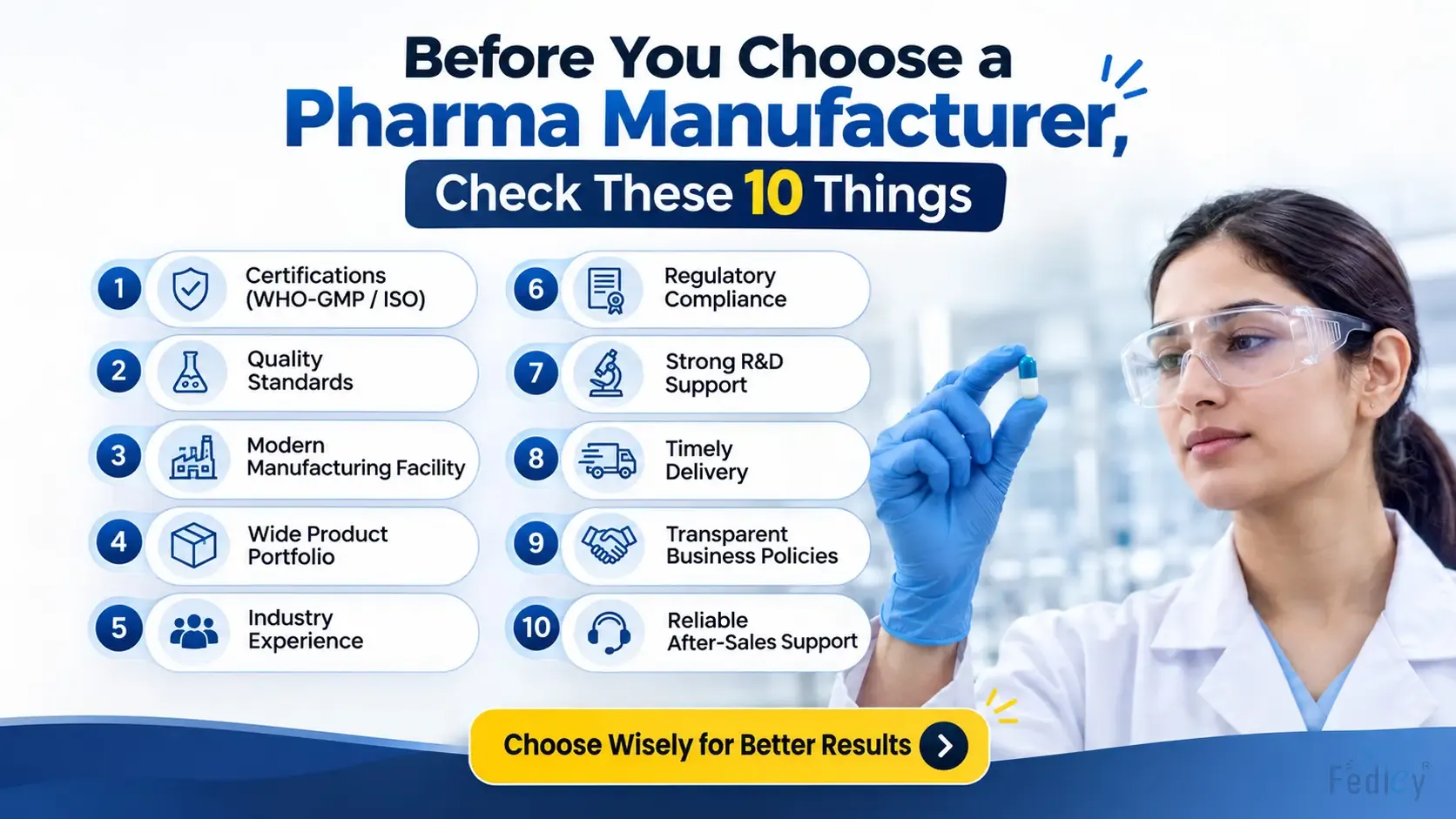
Your 60-Second Pharma Manufacturer Screening Checklist
Before moving forward with any pharmaceutical manufacturing company, quickly check these essential points:
- Certifications: Verify applicable GMP certifications, licenses, and regulatory credentials.
- Experience: Check relevant pharmaceutical manufacturing and dosage-form experience.
- Manufacturing Facility: Review the facility's infrastructure, equipment, technology, and production environment.
- Quality Control: Understand the manufacturer's QC and QA procedures for maintaining product quality.
- Product Range: Confirm whether the manufacturer can support your current and future product requirements.
- Production Capacity: Ensure they can handle your required order volumes and future demand.
- Pricing: Compare complete and transparent quotations, including applicable MOQ and packaging costs.
- Delivery: Confirm realistic production timelines, dispatch schedules, and supply reliability.
- Packaging: Check packaging, labeling, documentation, and product presentation capabilities.
- Partnership: Evaluate communication, customer support, transparency, and long-term reliability.
Quick Tip: A manufacturer that performs well across all these areas gives you a stronger foundation for a reliable, long-term pharmaceutical manufacturing partnership.
Warning Signs You Shouldn't Ignore
Not every manufacturer that makes a good first impression will be a good long-term partner.
Be cautious if you encounter:
- Unclear certification details
- Unusually low pricing without a clear explanation
- Poor or delayed communication
- Vague production timelines
- Limited quality documentation
- Difficulty explaining manufacturing processes
- Unclear product specifications
- Promises that appear unrealistic
These signs do not automatically mean a manufacturer is unsuitable, but they should encourage you to ask more questions and verify more information before proceeding.
7 Questions to Ask Before Signing the Manufacturing Agreement
Before committing to a third-party pharma manufacturer, ask:
- What certifications and manufacturing licenses do you hold?
- Have you manufactured products similar to mine?
- What quality-control procedures are followed?
- What is your current production capacity?
- What is the minimum order quantity?
- What is the expected manufacturing and delivery timeline?
- What documentation and support will you provide?
The quality of the answers can tell you a lot about how professionally the manufacturer operates.
Third-Party Manufacturing vs. Contract Manufacturing: Which Fits Your Business?
For businesses without their own manufacturing infrastructure, outsourcing can be a practical way to bring pharmaceutical products to market.
Third-party pharma manufacturing allows businesses to work with an established manufacturer for production while focusing more heavily on areas such as marketing, distribution, sales, and business development.
Contract manufacturing can also be useful, depending on the specific responsibilities, development requirements, ownership arrangements, and manufacturing agreement.
The right model depends on your product, resources, technical requirements, commercial goals, and level of control you need.
If you're deciding between the two, review Contract vs Third-Party Manufacturing before making a decision.
For businesses specifically researching Indian manufacturing opportunities, Best 3rd Party Pharma Manufacturing in India can also be a useful next resource.
When Manufacturing Becomes a Growth Strategy
A good manufacturer can become more than a production vendor.
As your business develops, a capable manufacturing relationship may support product expansion, larger orders, new markets, improved supply planning, and a broader pharmaceutical portfolio.
That is why it makes sense to think beyond your first order.
Can the manufacturer support your next product?
Can it handle increased demand?
Can its communication and quality systems scale with your business?
These questions shift the conversation from simply buying pharmaceutical products to building a sustainable pharma manufacturing partnership.
Businesses looking at broader pharmaceutical partnerships can also explore the Benefits of Partnering with Leading Pharma Companies.
The Right Manufacturer Should Make Your Business Easier, Not Harder
Choosing the right pharma manufacturer is ultimately about reducing business risk and building confidence.
The right partner should have the appropriate credentials, relevant manufacturing experience, suitable infrastructure, reliable pharmaceutical quality control, adequate production capacity, transparent pricing, dependable delivery, proper documentation, and responsive communication.
But don't stop at the first successful order.
Think about where your business could be six months, one year, or several years from now. Your ideal pharmaceutical manufacturing partner should be capable of supporting that journey.
Whether you're considering third-party pharma manufacturing, contract manufacturing, or a broader pharmaceutical production partnership, take the time to ask the right questions before making a commitment.
Because the best manufacturer isn't necessarily the one that gives you the lowest quote.
It's the one that can consistently deliver the quality, reliability, capability, and support your business needs to grow.
Looking for a Pharma Manufacturing Partner?
If you're evaluating options for pharmaceutical manufacturing, third-party production, or long-term manufacturing support, take the time to discuss your product requirements directly with a prospective partner.
Fedley Healthcare
Location: Plot No. 201, Ground Floor, HSIIDC, Alipur, Phase 1, Industrial Area, Barwala (PKL), Haryana – 134118
Email: fedleycare[@]gmail.com
Phone: +91-9855986633 | +91-9317692852 | +91-9888656719
A thoughtful manufacturer selection process today can save considerable time, cost, and operational stress tomorrow.
Frequently Asked Questions About Choosing a Pharma Manufacturer
● What should I check before choosing a pharma manufacturer?
Check applicable GMP and regulatory credentials, manufacturing experience, facility infrastructure, quality-control systems, product capabilities, production capacity, pricing, delivery timelines, packaging, documentation, reputation, and communication.
● How do I find a reliable pharma manufacturer?
Start by defining your product requirements and shortlist manufacturers with relevant capabilities. Then verify certifications, assess quality systems, compare pricing and capacity, discuss delivery timelines, and evaluate communication before entering a long-term agreement.
● What certifications should a pharma manufacturer have?
The appropriate certifications and licenses depend on the products, market, dosage forms, and applicable regulations. Ask the manufacturer to provide relevant documentation and verify that its manufacturing standards are appropriate for your requirements.
● Why is quality control important in pharmaceutical manufacturing?
Quality control helps ensure that raw materials, manufacturing processes, and finished products meet established specifications. Consistent quality systems are essential for producing pharmaceutical products reliably.
● How important is production capacity?
Production capacity is important because your requirements may increase as your business grows. A manufacturer should ideally be capable of meeting current demand while providing a realistic path for handling larger future orders.
● Should I choose a pharma manufacturer based only on price?
No. Compare overall value rather than price alone. Quality, regulatory compliance, production capacity, delivery reliability, packaging, documentation, communication, and support can all affect the actual cost and success of your manufacturing relationship.
● What should I ask a third-party pharma manufacturer?
Ask about certifications, relevant manufacturing experience, quality-control systems, production capacity, MOQ, pricing, production timelines, packaging, documentation, logistics, and ongoing support.
Disclaimer:
This article is for general informational and educational purposes only and does not constitute medical, legal, regulatory, financial, or business advice. Pharmaceutical manufacturing requirements, certifications, licenses, quality standards, pricing, and regulatory obligations may vary by product, location, and market. Before choosing a pharma manufacturer, independently verify its certifications, licenses, quality systems, manufacturing capabilities, documentation, pricing, and contractual terms. Businesses should consult qualified pharmaceutical, regulatory, legal, or technical professionals when necessary.
Any reference to Fedley Healthcare or pharmaceutical manufacturing services is informational and does not guarantee product quality, regulatory approval, pricing, delivery timelines, availability, or business outcomes.