Why Pediatric Drops and Syrups Are Commonly Used in Children's Healthcare
A medicine cabinet may contain tablets, capsules, creams, drops, and syrups, but when the patient is a baby or young child, liquid medicine for children often gets special attention.
Why?
Because children don't always find tablets or capsules easy to swallow. More importantly, their medication needs can differ according to age, weight, formulation, and the medicine being prescribed. That's why pediatric drops and syrups have become familiar pediatric dosage forms in children's healthcare.
From a few carefully measured drops to a spoonful- or, more accurately, a measured volume of syrup these formulations are designed to make oral administration more practical.
But there's a bigger story behind that little bottle.
The choice between pediatric drops, syrups, suspensions, or another pediatric oral formulation involves much more than convenience. Formulation, concentration, dosage accuracy, age suitability, storage, and administration all have a role to play.
So, let's look beyond the bottle and understand why pediatric liquid medicines continue to be widely used.
A Tablet Isn't Always the Easiest Answer for a Child
For an adult, swallowing a tablet may be routine.
For a toddler, it can be an entirely different experience.
Younger children may struggle with solid dosage forms, while infants may not be developmentally ready to swallow them safely. Even when a child can swallow a tablet, the experience may not always be easy or acceptable.
This is where oral liquid medicines for children can offer a practical alternative when an appropriate formulation is available.
A liquid format may allow healthcare professionals to prescribe or recommend a specific measured quantity rather than asking a young child to swallow a solid unit.
That makes pediatric medication administration a little more practical for caregivers.
But there's an important distinction:
A liquid formulation is not automatically suitable simply because it is liquid.
The medicine, strength, concentration, age suitability, and instructions must always be considered.
What Exactly Are Pediatric Drops and Syrups?
Think of pediatric liquid medicines as a broad family rather than a single product type.
This family can include:
- Pediatric drops
- Pediatric syrups
- Oral solutions
- Oral suspensions
- Other liquid dosage forms
Each formulation can have different characteristics.
A drop formulation may be designed for administration in a relatively small volume. A syrup or suspension may be intended to provide a larger measured quantity.
The active ingredient, concentration, excipients, storage conditions, and instructions can also vary.
That's why two bottles containing liquid medicines should never be assumed to be interchangeable.
The "Pediatric" Difference
The term pediatric dosage forms refers to formulations intended for children and developed with their particular administration requirements in mind.
Depending on the product, formulation considerations can include:
- Appropriate strength
- Concentration
- Administration volume
- Palatability
- Packaging
- Measuring device
- Stability
- Age suitability
In other words, creating a children's medicine isn't simply about making an adult formulation smaller.
It requires careful pharmaceutical consideration.
For businesses exploring this category, Fedley Healthcare provides a dedicated Pediatric Drops product category featuring multiple liquid products.
Why Are Liquid Medicines So Common in Children's Healthcare?
There isn't one universal reason.
Instead, several practical factors explain the popularity of liquid medicine for children.
1. Swallowing Can Be Easier
One of the most obvious advantages is straightforward: some children find liquids easier to take than tablets or capsules.
This can be especially relevant for infants and younger children who have difficulty swallowing solid dosage forms.
A suitable child-friendly medicine can therefore make administration more manageable.
However, taste and texture can also influence whether a child accepts a particular liquid.
So while liquid formulations can solve one problem, formulation developers still need to think about the overall experience of taking the medicine.
2. Small Volumes Can Be Measured
Many pediatric medicines are administered in measured liquid quantities.
This can be useful when a healthcare professional prescribes a particular volume based on the individual medicine and patient.
But here's where caregivers need to pay attention:
A small dose does not mean casual measurement.
Measure the quantity using the appropriate device and follow the medicine's specific instructions.
An oral syringe for children, for example, can help measure small liquid quantities accurately.
3. Children Have Different Healthcare Needs
A child is not simply a smaller version of an adult.
Age, weight, development, medical condition, and other factors can influence how medicines are selected and administered.
This is one reason the pharmaceutical industry offers multiple pediatric dosage forms.
For some children and medicines, an oral liquid may be an appropriate option. For others, a different dosage form may be recommended.
The formulation should always match the medicine and the patient's needs.
4. Liquid Formulations Offer Variety
Another reason pediatric liquid formulations remain important is their versatility.
Different medicines may be developed as:
Drops → Solutions → Suspensions → Syrups
These aren't interchangeable categories.
Each formulation is created according to the characteristics of the medicine and its intended use.
That's why a strong Pharmaceutical Product Guide should explain not only the product name, but also its dosage form, strength, ingredients, intended use, and administration information.
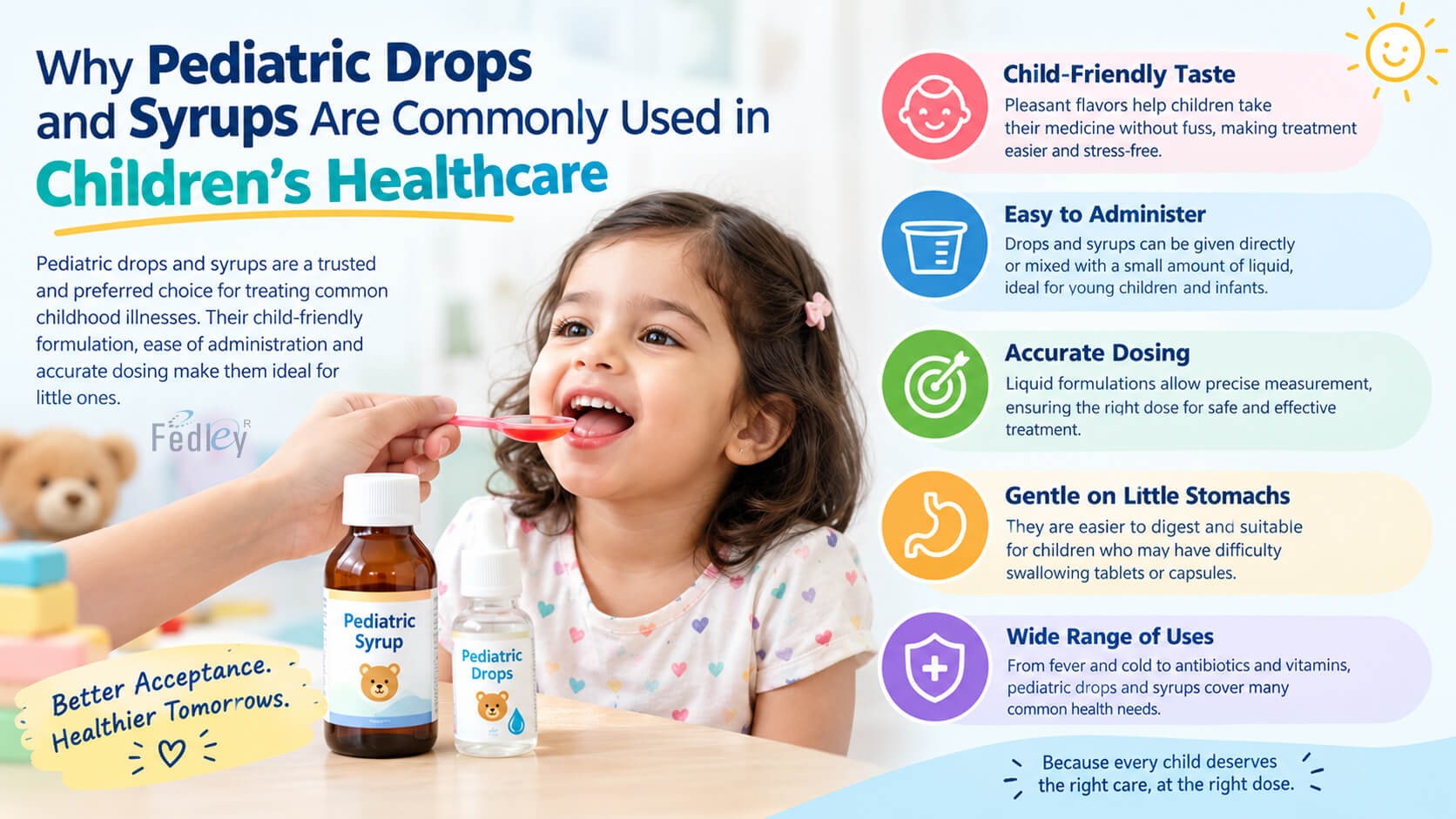
Pediatric Drops vs Syrup: What's Really Different?
This is one of the most common points of confusion.
If both are liquids, why aren't they simply the same thing?
Because pediatric drops vs syrup involves more than the appearance of the product.
💧 Pediatric Drops
- Dosage Form: Liquid
- Administration: Designed for measured small-volume administration where appropriate
- Measuring Device: Dropper or supplied measuring device, where applicable
- Concentration: Varies by product
- Intended Age: Depends on the specific product
- Active Ingredient: Product-specific
- Key Consideration: Accurate measurement is important. Always follow the product label and use the supplied device when provided.
🥄 Pediatric Syrups
- Dosage Form: Liquid
- Administration: Usually provided for measured liquid administration
- Measuring Device: Oral syringe, measuring cup, or supplied device, where applicable
- Concentration: Varies by product
- Intended Age: Depends on the specific product
- Active Ingredient: Product-specific
- Key Consideration: Accurate measurement is essential. Follow the product label and use the appropriate measuring device.
So, which is better?
Neither is universally "better."
The appropriate formulation depends on the medicine, concentration, intended patient, and healthcare professional's recommendation.
Fedley Healthcare separately lists Pediatric Drops and Syrups, reflecting the distinction between these dosage-form categories.
The Most Important Part? Measuring the Medicine Correctly
Here's the part that deserves more attention than it usually gets.
Even a well-formulated pediatric liquid medicine needs to be measured correctly.
A household teaspoon may look convenient, but it isn't designed to provide a consistently precise medicine measurement.
Instead, caregivers should use the measuring device supplied with the product or recommended by a healthcare professional.
A simple rule:
Don't estimate. Measure.
This becomes particularly important when only a small quantity is required.
An oral syringe for children can make it easier to measure small volumes accurately.
Caregivers should also follow any instructions about shaking a suspension, preparing a product, storage, or refrigeration.
And if the instructions aren't clear?
Ask a pharmacist or healthcare professional.
What Makes a Medicine "Child-Friendly"?
The phrase child-friendly medicine sounds simple, but pharmaceutical formulation is anything but simple.
For a child to successfully take an oral medicine, several practical factors may matter:
1. Taste: Children can be sensitive to unpleasant flavours.
2. Texture: The physical feel of a liquid can affect acceptance.
3. Volume: A very large quantity may be difficult for a young child to take.
4. Administration method: The appropriate measuring device can make administration easier.
5. Packaging: Clear labelling and appropriate packaging are important for safe use.
These considerations can influence the development of pediatric oral formulations.
However, "child-friendly" should never be interpreted as permission to alter the medicine. Caregivers should follow the product directions and professional advice.
It's Not Just Syrup: The Pediatric Liquid World Is Much Bigger
When people hear "children's liquid medicine," they often think only about syrup.
Drops and syrups are just the beginning; the pediatric pharma world goes much further.
Depending on the portfolio, products may include:
1. Digestive Drops for Children
2. Pediatric Respiratory Drops
3. Antibiotic oral drops
4. Pediatric suspensions
5. Children's Nutritional Syrups
6. Vitamin and mineral formulations
7. Other oral liquid preparations
The purpose of each product is different.
For example, Fedley Healthcare's portfolio includes PODFED DROP, a cefpodoxime 25 mg drop formulation, and COLIFED DROP, a simethicone-based oral drop formulation.
These examples demonstrate an important point:
The dosage form tells you how a product is delivered, not necessarily what it is used for.
The active ingredients, strength, formulation, intended use, and product information must always be checked individually.
A Closer Look at Pediatric Drops
Consider the difference between two products that are both supplied as drops.
PODFED DROP contains cefpodoxime and is presented as a 25 mg drop formulation. COLIFED DROP contains simethicone along with dill oil and fennel oil.
Although both are pediatric drops, their formulations and purposes are completely different.
That is why consumers should never assume that one drop product can replace another.
For healthcare professionals and pharmaceutical businesses, the same principle applies when reviewing a Pediatric Healthcare Products portfolio.
The dosage form is only one part of the product story.
Where Pharmaceutical Innovation Comes In
What happens before a pediatric liquid reaches a pharmacy shelf?
Quite a lot.
Developing pediatric liquid formulations can involve decisions around formulation design, manufacturing, quality control, packaging, stability, labelling, and regulatory requirements.
This is where Healthcare Innovations and pharmaceutical manufacturing capabilities intersect.
A successful product isn't simply one that contains the intended active ingredient.
It also needs to be manufactured consistently and presented in a format that supports appropriate administration.
For pharmaceutical companies entering the liquid-medicine segment, choosing the right manufacturing relationship can therefore be an important part of the process.
Businesses interested in developing their own syrup products can explore Fedley Healthcare's Launch Your Own Syrup Brand resource for information about third-party syrup manufacturing.
Five Things to Remember About Children's Liquid Medicines
01 — Liquid Doesn't Mean One-Size-Fits-All
Every pediatric liquid medicine has its own formulation, concentration, and instructions.
02 — Drops Aren't Automatically the Same as Syrups
Pediatric drops and pediatric syrups can differ significantly.
03 — Measurement Matters
Always use the recommended measuring device for accurate medicine dosing for children.
04 — Age Suitability Matters
Not every liquid medicine is appropriate for every age group.
05 — Professional Guidance Still Matters
When there's uncertainty about a medicine or dose, speak with a qualified healthcare professional.
Why Are Liquid Medicines Used for Children?
Liquid medicines are commonly used for children because they can be easier to administer than tablets or capsules, particularly for younger children who have difficulty swallowing solid dosage forms. Depending on the formulation, liquid medicines can also allow a specified quantity to be measured using an appropriate device.
From a Small Bottle to a Bigger Healthcare Picture
A bottle of drops or syrup may look like a simple healthcare product.
But behind it is a combination of pharmaceutical science, formulation development, manufacturing, quality control, packaging, and careful administration.
That's why pediatric drops and syrups remain important in children's healthcare.
For caregivers, the priority is simple: use the appropriate product, follow its instructions, measure it correctly, and seek professional advice whenever there is uncertainty.
For pharmaceutical companies, the opportunity is broader.
The demand for reliable Pediatric Healthcare Products, innovative pediatric oral formulations, and practical liquid dosage forms creates space for manufacturers and pharmaceutical partners to develop focused product portfolios.
Fedley Healthcare brings together pharmaceutical products and business-focused manufacturing opportunities for companies exploring different healthcare segments.
For businesses looking for a Trusted Pharma Partner, understanding the formulation, manufacturing, documentation, and supply requirements behind pediatric products is an important first step.
Ultimately, good pediatric healthcare isn't about making medicine simply "smaller."
It's about making the right formulation, for the right patient, with the right information, and supporting its responsible use.
And sometimes, that means the medicine comes in a little bottle of drops or syrup.
Ready to Take the Next Step in Pediatric Pharma?
From pediatric product portfolios to strategic market expansion, the right pharmaceutical partner can make the journey simpler. Fedley Healthcare brings together manufacturing, promotion, franchise, and business-support solutions under one roof.
Choose Your Growth Route →
Services | Ethical Promotion | Third Party Manufacturing | PCD Franchise Services
For pharmaceutical businesses looking to develop or expand a liquid-medicine portfolio, Fedley Healthcare can serve as a potential manufacturing and business-support partner.
Fedley Healthcare
- Plot No. 201, Ground Floor, HSIIDC, Alipur, Phase 1, Industrial Area, Barwala (PKL), Haryana – 134118
- Email: fedleycare[@]gmail.com
- Phone: +91-9855986633 | +91-9317692852 | +91-9888656719
Frequently Asked Questions
01. Why are pediatric drops and syrups commonly used?
Pediatric drops and syrups provide liquid dosage forms that may be easier for some younger children to take than tablets or capsules. Their use depends on the specific medicine and the child's needs.
02. Why are liquid medicines easier for some children?
Some younger children have difficulty swallowing solid dosage forms. A suitable oral liquid medicine can provide an alternative when that formulation is appropriate.
03. What is the difference between pediatric drops and syrups?
Pediatric drops vs syrup involves differences in formulation, concentration, administration volume, and intended use. They should not be considered interchangeable.
04. Are all pediatric drops suitable for infants?
No. Oral drops for infants must be specifically appropriate for the intended age group. Always check the individual product information and follow professional advice.
05. How should liquid medicine for children be measured?
Use the measuring device supplied with the product or recommended by a healthcare professional. An oral syringe for children can be useful for measuring small quantities.
06. Why is accurate dosing important in pediatric healthcare?
Children may require carefully determined medicine quantities, and liquid products can have different concentrations. Correct measurement is therefore an important part of pediatric medication administration.
07. Are all children's syrups the same?
No. Children's syrups can contain different active ingredients, strengths, formulations, and intended uses. Never assume that one syrup can substitute for another.
Disclaimer:
This article is for general educational purposes only and should not replace professional medical advice, diagnosis, or treatment. Children’s medicines should be used only as directed by a qualified healthcare professional or product label. Do not change, start, stop, or combine medicines without guidance. Always seek medical advice for concerns or unexpected reactions.